

A project can be technically sound and still fail to become investable if its essential parts don’t align. An energy infrastructure project developer brings land, power, technology, capital and delivery into a coherent pathway from early concept to execution.
The role extends beyond identifying an opportunity. A developer shapes the project, coordinates specialist partners and works through how physical assets, energy supply and digital requirements fit together. That’s distinct from an EPC contractor, consultant or asset owner, each of which has a different role in the project lifecycle.
As partners and workstreams multiply, accountability can become unclear. This article explains what a developer is responsible for, where the role’s boundaries sit and how each stage connects to the next. It also outlines practical ways to test assumptions, clarify partner responsibilities and structure an opportunity for further development.
AP3 Global develops opportunities across energy, technology, infrastructure and data centres, coordinating land, power, technology, capital and specialist delivery partners. The sections ahead explain how this integrated approach connects the work from origination through to delivery planning.
Key Takeaways
- An energy infrastructure project developer shapes an opportunity into a coordinated project pathway, distinct from the roles of asset owners, advisers, capital partners and EPC contractors.
- Use project stages and decision gates to test assumptions, dependencies and readiness before advancing towards delivery.
- Clarify what each partner contributes, and how responsibilities and decisions are divided within the project structure.
- Assess a development approach by how well it integrates workstreams, establishes accountability, sequences decisions and considers the asset’s intended function.
- AP3 Global coordinates land, power, technology, capital and specialist delivery partners across energy, technology, infrastructure and data centres.
What an Energy Infrastructure Project Developer Does
An energy infrastructure project developer shapes an opportunity into a coordinated project pathway by aligning land, power, technology, capital and specialist delivery partners. The developer identifies and develops the opportunity, organises planning and connects workstreams so the project can be assessed and advanced. The role is distinct from owning or operating the resulting asset, providing advice alone, supplying capital or carrying out construction.
The wider context is energy development, a field spanning the production of energy from fossil fuels, nuclear and renewable sources. Within it, the developer’s contribution is coordination: connecting a project’s physical requirements, technical design and commercial pathway rather than treating each as a separate task.
Where the Developer Role Begins and Ends
Origination and coordination. The developer identifies an opportunity, frames its objectives and organises the work needed to assess and advance it. This can include bringing together land considerations, energy supply, technology needs, capital requirements and specialist delivery input. The developer also helps make dependencies visible, such as how a change in power requirements could affect technical scope or delivery planning.
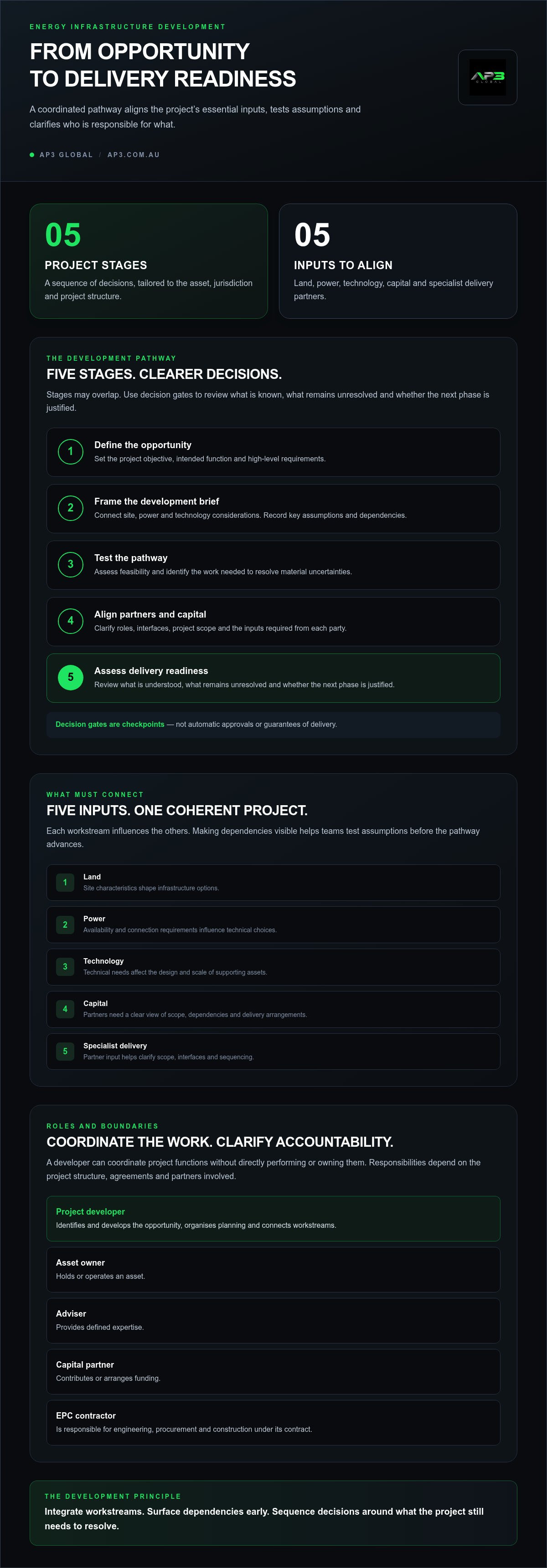
The boundary matters. An asset owner holds or operates an asset; an adviser provides defined expertise; a capital partner contributes or arranges funding; and an EPC contractor is responsible for engineering, procurement and construction under its contract. A developer may coordinate these functions without performing them directly. Responsibilities depend on the project structure, agreements and partners involved.
Why Integrated Development Matters
Project components are interdependent. Land characteristics can shape infrastructure options, while power availability and connection requirements influence technical choices. Technology needs affect the design and scale of supporting assets. Capital partners need a sufficiently clear view of scope, dependencies and delivery arrangements to assess an opportunity. If these workstreams progress in isolation, assumptions can diverge before the project pathway is established.
Consider a proposed energy asset intended to support a digital infrastructure facility. The facility’s power needs inform the energy concept; land and infrastructure considerations shape where and how the components could connect; and technology specifications influence the development plan. The developer coordinates these inputs and surfaces dependencies early. That does not remove uncertainty or guarantee delivery, but it creates a clearer basis for testing readiness and deciding what work should follow.
How an Energy Infrastructure Project Advances from Concept to Delivery
Project development moves through a sequence of decisions, not a universal timetable. An energy infrastructure project developer coordinates workstreams and tests whether the opportunity remains coherent as objectives, constraints and partner inputs become clearer. Stages may overlap, and their order or depth can vary with the asset type, jurisdiction and project structure.
The U.S. Environmental Protection Agency’s Project Development Process provides a reference for renewable energy projects. The same broad discipline applies across infrastructure: define the opportunity, develop the pathway, test readiness and align delivery, while tailoring the process to the project.
From Opportunity Definition to Development Planning
The initial brief sets out the project’s purpose, intended users and core infrastructure requirements. Early consideration of land, power and technology helps reveal dependencies. Site characteristics inform what may be feasible, energy needs influence infrastructure planning, and technical requirements shape the project scope. In Australia, market conditions and jurisdictional context can also influence the pathway. Test relevant assumptions for the specific project rather than treating them as universal rules.
From Partner Alignment to Delivery Readiness
As planning develops, capital partners, technical specialists and prospective delivery partners can help clarify scope, dependencies and sequencing. Their input is most useful when responsibilities and interfaces are visible. For example, if technical requirements change after delivery planning has advanced, revisit the scope, assumptions and partner arrangements before progressing.
Decision gates provide structured points to assess these issues. They are not automatic approvals or guarantees of delivery. At each gate, establish what is understood, what remains unresolved and whether the next phase is justified.
- 1. Define the opportunity. Set the project objective, intended function and high-level requirements.
- 2. Frame the development brief. Connect site, power and technology considerations, recording key assumptions and dependencies.
- 3. Test the pathway. Assess feasibility and identify the work needed to resolve material uncertainties.
- 4. Align partners and capital. Clarify roles, interfaces, project scope and the inputs required from each party.
- 5. Assess delivery readiness. Review whether the development plan, partner arrangements and outstanding decisions support progression.
This sequence is a planning framework, not a fixed schedule. A project may return to an earlier decision gate when new information changes its assumptions. AP3 Global’s development approach brings these workstreams together across energy, technology, infrastructure and data centres.
How Developers Coordinate Energy, Technology and Infrastructure Partners
Infrastructure projects bring together organisations with different responsibilities, decision rights and time horizons. Clear role definitions connect technical work with commercial decisions, so a change to one project element can be assessed across the wider programme. The structure varies by project; not every development uses the same partners or separates every function into a different organisation.
| Project function | Typical contribution | Primary focus |
|---|---|---|
| Developer | Shapes the opportunity, organises development planning and coordinates partners and interfaces. | Coherence of the project pathway, scope, dependencies and progression. |
| Asset owner | Holds or operates the asset, depending on the agreed structure. | Ownership, operational objectives and long-term asset considerations. |
| Capital partner | Contributes or arranges capital and may inform project structuring. | Investment decisions, commercial structure and the basis for progression. |
| Consultant | Provides defined technical, commercial or other specialist advice. | Analysis and recommendations within an agreed scope. |
| EPC contractor | Undertakes engineering, procurement and construction under its contract. | Construction delivery and the responsibilities set out in that contract. |
Developer, Asset Owner and Capital Partner
These roles address different decisions. The developer coordinates project shaping; the asset owner focuses on ownership or operation; and the capital partner assesses and participates in investment or financing decisions. A capital partner may also contribute to structuring as the opportunity develops. Each party’s responsibilities, participation and decision rights depend on the project’s agreed commercial arrangements.
Developer, Consultant and EPC Contractor
Development coordination is not the same as specialist advice or construction delivery. Consultants contribute defined expertise at relevant stages, while an EPC contractor may be engaged for contracted engineering, procurement and construction. Their input can inform project planning, but the developer’s function is to coordinate how the workstreams connect, not to assume every specialist’s role.
Interfaces make that distinction practical. If technical requirements change, for example, the developer can coordinate an assessment of implications for infrastructure scope, capital assumptions and delivery planning. Clear ownership of inputs, decisions and handovers helps partners locate an issue and identify what needs to be resolved next. An energy infrastructure project developer maintains a joined-up view across physical assets, power and digital requirements, while the agreed structure determines who owns, funds, advises on or delivers each component.
How to Assess an Energy Infrastructure Project Development Approach
A development model should do more than convene participants. It should help decision-makers understand how project objectives connect to workstreams, who is accountable for each interface and what must be resolved before the next decision. Use the framework below to assess whether coordination is making project readiness clearer, rather than adding another layer of process.
Test Integration Across Core Project Inputs
Assess whether land, power, technology, capital and delivery are treated as connected inputs to one project pathway. An energy infrastructure project developer should make the dependencies between these areas visible, so changes in one workstream can be considered against the others. No framework guarantees success; the value lies in disciplined coordination and clear decision-making.
- Integration: Are project objectives translated into defined workstreams, with links between land, power, technical requirements, capital and delivery planning?
- Accountability: Is there a clear owner for each key interface, input and decision, including where responsibilities pass between partners?
- Sequencing: Are decisions ordered so critical assumptions and dependencies are tested before they underpin later commitments?
- Readiness: Can decision-makers distinguish resolved matters from open questions and see what evidence or partner input is needed to progress?
- Adaptability: Is there a process for reviewing assumptions when project requirements or relevant conditions change?
Assess Readiness, Adaptability and Accountability
Look for a development plan that is revisited as information emerges, rather than treated as fixed once drafted. If technical requirements shift, for example, the project model should make it possible to identify which scope, partner inputs or commercial assumptions need review, and who is responsible for that review.
Long-term adaptability should reflect the asset’s intended function. The aim isn’t to add capacity or flexibility without purpose, but to understand whether the proposed infrastructure can remain aligned with its operational needs as those needs evolve. This keeps scalability connected to project objectives rather than treated as a standalone claim.
Use the checklist to identify gaps, not to seek a guarantee. Strong coordination makes responsibilities, dependencies and next decisions easier to assess; it cannot remove uncertainty or replace project-specific judgement. AP3 Global’s development approach integrates work across energy, technology, infrastructure and data centres.
AP3 Global’s Integrated Approach to Energy Infrastructure Development
Energy, technology, infrastructure and data centres increasingly depend on connected physical and digital systems. AP3 Global is an Australian-founded development firm working across these sectors, identifying and developing opportunities by coordinating land, power, technology, capital and specialist delivery partners. It brings these inputs into a coherent development pathway, with responsibilities shaped by each project’s structure and partner arrangements.
Bringing Connected Infrastructure Opportunities Together
AP3 Global’s approach starts with the relationship between project components. Land, energy requirements, technical needs, capital considerations and specialist delivery input are treated as connected parts of development planning, rather than isolated workstreams. This coordination helps clarify how decisions in one area may affect scope, sequencing and readiness elsewhere.
The model reflects the assessment principles set out in this guide: integration across core inputs, clear accountability for interfaces, considered sequencing and attention to the asset’s intended long-term function. The aim is not to suggest that one structure suits every opportunity, but to organise the relevant workstreams around the project’s objectives and dependencies.
AP3 Global brings a global outlook grounded in local insight and international partnerships. It convenes relevant expertise and aligns partner contributions around the opportunity, while specialist parties retain their defined roles. Development coordination is distinct from direct construction or EPC delivery.
A Practical Next Step for Project and Capital Partners
For a structured partnership discussion, start with a clear account of the opportunity and its current development position. This can include the intended project function, land and power considerations, technology requirements, capital context, key dependencies and the decisions or specialist inputs needed to progress. Clarity on these elements helps establish where objectives align and which interfaces need further development.
An energy infrastructure project developer can frame these discussions by bringing project and partner perspectives into one view. The value lies in making the pathway, responsibilities and open questions easier to assess, not in promising a particular outcome. AP3 Global develops opportunities across energy, technology, infrastructure and data centres, coordinating the inputs needed to shape a project pathway.
Review AP3 Global’s development approach and partnership pathways for context on how connected project opportunities are developed.
Build a More Coherent Path from Opportunity to Delivery
Strong infrastructure development depends on more than a sound concept. It requires clear accountability, sequenced decisions and coordination across land, power, technology, capital and delivery. An energy infrastructure project developer connects these workstreams, while decision gates provide a structured way to test assumptions and readiness as the project evolves.
Partner roles also matter. Developers shape and coordinate the pathway; asset owners, capital partners, consultants and EPC contractors contribute distinct functions according to the project’s structure. Assessing how these responsibilities fit together can reveal whether development activity is advancing the project’s objectives and long-term requirements.
AP3 Global is an Australian-founded development firm working across energy, technology, infrastructure and data centres. It coordinates land, power, technology, capital and specialist delivery partners to bring connected opportunities into a considered development pathway.
A clear view of the opportunity and its key interfaces is a constructive place to begin.
Frequently Asked Questions
What does an energy infrastructure project developer do?
An energy infrastructure project developer shapes an opportunity into a coordinated project pathway by aligning land, power, technology, capital and specialist delivery partners. The developer identifies and develops opportunities, organises planning and helps clarify dependencies, responsibilities and decisions needed to progress. The role differs from asset ownership, specialist advice, investment and construction delivery. The project structure determines how these functions are divided and which partners participate at each stage.
What is the difference between a project developer and an EPC contractor?
A project developer coordinates the opportunity and its development pathway, while an EPC contractor delivers contracted engineering, procurement and construction work. The developer helps define project scope, coordinate partner inputs and track dependencies across workstreams. The EPC contractor’s responsibilities are set by its contract and relate to construction delivery. They are distinct functions, although an EPC contractor may contribute during development planning or be engaged later in the project.
What are the main stages of energy infrastructure project development?
Common stages include defining the opportunity, preparing a development brief, testing the pathway, aligning partners and capital, and assessing delivery readiness. Decision gates help determine whether assumptions and dependencies have been examined sufficiently to progress. These stages are a planning framework, not a universal timetable. Projects may overlap or revisit earlier decisions as new information emerges, and the process can vary with the asset, jurisdiction and agreed project structure.
How do developers bring land, power and capital together?
Developers coordinate these inputs by connecting project objectives with site considerations, energy requirements and the capital needed to advance the opportunity. A proposed infrastructure asset’s intended function shapes its power and technology needs, while land characteristics influence how the project may be planned. Capital partners can inform project structuring and investment decisions. Clear responsibilities and visible dependencies help partners assess how these elements fit together.
When should an organisation engage an energy infrastructure project developer?
Engage a developer when an organisation has an infrastructure opportunity but needs to coordinate its core requirements, partners or development pathway. Early involvement can help frame project objectives, connect land and power considerations with technology needs, and identify decisions that require further work. A developer may also help align capital and specialist delivery input as planning advances. The appropriate scope depends on the opportunity and the roles already established.
How long does energy infrastructure project development take?
There is no single timeframe for energy infrastructure project development. Duration depends on factors such as the asset type, project structure, jurisdiction, site and power considerations, partner alignment and the work needed to test assumptions. Stages can overlap, while new information may require earlier decisions to be reviewed. A more useful measure than a generic timeline is whether key dependencies, accountabilities and readiness criteria are clear for the project’s next decision.
How does an energy infrastructure developer support data centre projects?
An energy infrastructure project developer can coordinate the physical and digital requirements that shape data centre development, including land, power, technology, capital and specialist delivery partners. This integrated view helps clarify how energy needs relate to infrastructure planning and the facility’s intended function. AP3 Global develops data centre opportunities and works across energy, technology and infrastructure, coordinating project inputs rather than providing colocation or cloud hosting services.
For project and capital partners exploring an aligned opportunity, connect with AP3 Global about its development and partnership pathways.
