

A compelling energy opportunity is not yet an executable project. Energy project development services bring essential inputs into alignment, connecting land, power, technology, capital and delivery partners around a coherent pathway from concept to investment readiness.
The challenge is rarely a shortage of promising ideas. It is resolving dependencies between the site, grid access, technical requirements, commercial structure and the parties responsible for each stage. When those interfaces are unclear, a project can appear viable without a practical route forward.
This article explains the scope and sequence of energy project development, from assessing an opportunity and aligning its core requirements to establishing a delivery framework. It also outlines the capabilities and partner interfaces a project needs as it advances. AP3 Global works across energy, technology, infrastructure and data centre opportunities, coordinating relevant inputs and specialist delivery partners to shape a coherent development pathway.
Key Takeaways
- Energy project development services connect an opportunity’s core workstreams while distinguishing development from design, construction, ownership and operations.
- Map the sequence from initial assessment to delivery readiness, allowing stages to overlap and vary with the project.
- Clarify who leads coordination and how responsibilities pass between the project owner, development support and technical partners.
- Assess land, power, technology, capital and delivery capacity as linked inputs, with evidence requirements shaped by the project.
- AP3 Global brings these inputs and specialist partners together within a coordinated development framework.
What energy project development services coordinate across a project
A large-scale energy opportunity becomes executable through coordinated decisions, not through a concept alone. Energy project development services organise its commercial, physical and technical workstreams, identify dependencies and bring the relevant participants into a coherent development pathway.
Development is distinct from engineering design, construction delivery, asset ownership and ongoing operations. Engineering specialists develop technical solutions within an agreed scope; construction partners deliver defined works; owners hold the asset; and operators manage it once established. A developer works across these interfaces, helping determine how the project could progress and who needs to contribute at each stage.
A project developer coordinates the conditions for delivery; a single-discipline consultant advises on a defined part of the project. That distinction matters because land, power, technology, capital and delivery capacity depend on one another. A site may suit a technology in principle, for example, while its power pathway or commercial structure still needs assessment. The broader context of Renewable energy commercialization shows how technology deployment, investment and policy interact, although the development conditions for each project are specific to its context.
What does an energy project developer do?
A developer identifies and frames opportunities, organises the workstreams needed to assess them, and convenes participants around shared dependencies. This may include coordinating site and power considerations with technical input, commercial pathway development, capital discussions and specialist delivery planning.
The mandate depends on the project, its partners and agreed responsibilities. Development is strategic coordination, not a claim to perform every technical or construction task directly. Clear interfaces help participants understand which decisions they own, what information they need and how their work connects to the wider project.
Which capabilities sit within development services?
Capabilities are assembled around the opportunity rather than applied as a universal checklist. They may include:
- Opportunity assessment: define the project’s objectives and identify its key dependencies.
- Site and power considerations: assess land context alongside the project’s potential power pathway.
- Technology alignment: connect the proposed solution to the project’s requirements and wider infrastructure context.
- Commercial pathway formation: organise the assumptions and relationships that shape a viable development structure.
- Partner coordination: involve capital partners and specialist delivery teams at appropriate stages.
These capabilities can overlap, and their emphasis shifts with project scale, technology and context. To make the work practical, identify the decisions each workstream must inform, the evidence needed for those decisions and who is responsible for providing it. The aim is a clearer basis for decisions and partner alignment, not an assumption that every opportunity will advance or that one sequence suits every project.
How energy project development services progress from concept to execution
Development advances through a sequence of decisions, evidence and partner commitments. Energy project development services turn an initial opportunity into a structured pathway by testing its assumptions, defining the work required and clarifying what must be resolved before the next decision.
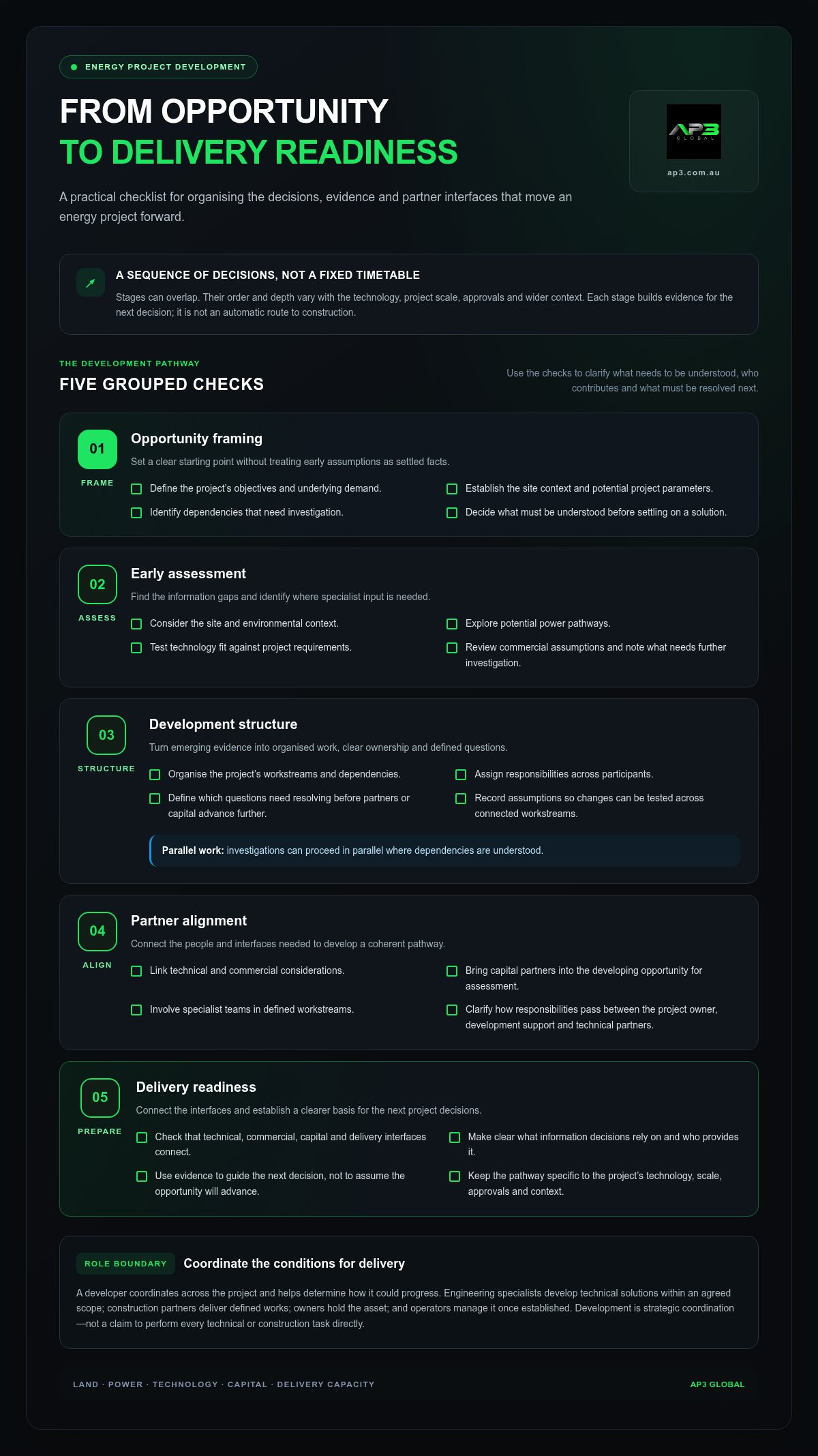
Opportunity framing, assessment, structuring, partner alignment and delivery readiness form a practical sequence, with each stage building evidence for the next decision. This is a guide, not a fixed timetable or an automatic route to construction. Workstreams can overlap, and their order and depth vary with the technology, project scale, approvals and wider context.
From opportunity framing to a development pathway
The initial frame establishes the project’s objectives, underlying demand, site context and potential parameters. It gives the team a basis for identifying dependencies without treating early assumptions as settled facts. At this stage, define what needs to be understood about the opportunity before committing to a particular solution.
Early assessment then identifies information gaps and where specialist input is needed. Site and environmental considerations, power pathways, technology fit and commercial assumptions may each require further investigation. The United States Environmental Protection Agency’s Renewable energy project development process offers a reference on preliminary screening and siting considerations. Project-specific requirements depend on location and context.
Assessment informs structure. Use emerging evidence to organise workstreams, assign responsibilities and define which questions need resolving before partners or capital are brought further into the process. Where dependencies are understood, investigations can proceed in parallel. Record the assumptions each workstream relies on so that changes in one area can be tested against the others.
From partner alignment to delivery readiness
As the project structure develops, technical, commercial, capital and delivery interfaces need to connect. Specialist teams contribute to defined workstreams; capital partners can assess the developing opportunity; and delivery partners can inform how the proposed scope could be implemented. Coordination makes dependencies visible, so decisions in one area can be weighed against their implications elsewhere.
Decision gates provide agreed points to review evidence, refine assumptions, proceed with further work or pause. They are not guarantees of progression. Their value is in making the basis for each decision explicit and recording unresolved matters before commitments deepen. A useful gate states what has been established, what remains open and who owns the next action.
Delivery readiness means the project has a sufficiently coherent framework for the next phase, with key inputs, responsibilities and interfaces understood. It does not mean construction is complete or the asset is commissioned and operating. For a coordinated view of how opportunities move through these stages, explore AP3 Global’s development approach.
How to assess development services, responsibilities and delivery interfaces
The value of a development partner depends on the work it is authorised to coordinate. A clear mandate defines the boundary between project ownership, strategic development, technical advice and delivery. Without that clarity, responsibilities can overlap, decisions can stall and important interfaces may be left unmanaged.
Development partner, engineering consultant or delivery contractor?
Assess each participant by its primary contribution, not its corporate label. An owner-led model keeps coordination with the asset owner; specialist development support adds capacity across selected workstreams; an engineering-led engagement centres on technical investigation or design. These models can work in combination, and none is universally preferable.
Engineering consultants develop defined technical outputs. EPC contractors are engaged for engineering, procurement and construction delivery within an agreed scope. AP3 Global coordinates specialist delivery partners as part of a broader development framework, including EPC partners, while direct construction delivery is undertaken by the relevant delivery partner.
| Model | Scope | Coordination responsibility | Partner interfaces and typical outputs |
|---|---|---|---|
| Owner-led development | Owner directs the project’s development work. | Owner retains coordination and decision authority. | Consultants and delivery partners report through the owner; outputs may include assessments, decisions and a project brief. |
| Specialist development support | Support covers agreed development workstreams or project-wide interfaces. | Responsibility is shared or delegated as set out in the mandate. | Coordinates relevant technical, commercial, capital and delivery inputs; outputs may include workstream plans and partner alignment. |
| Engineering-led engagement | Centres on defined technical investigation, design or advice. | Owner or appointed development lead coordinates the wider project. | Interfaces with project leads and other specialists; outputs are discipline-specific technical advice or design work. |
What should a development mandate make clear?
A mandate should make operating boundaries visible before workstreams multiply. Energy project development services create value when their scope connects to clear authority, reporting and partner interfaces, rather than adding another layer without defined decision rights.
- Objectives and scope: state the project outcomes sought and which workstreams are included or excluded.
- Authority and reporting: identify who makes decisions, who provides advice and how progress or material issues are escalated.
- Deliverables and interfaces: specify expected outputs, dependencies and how information passes between the owner, advisers and delivery partners.
- Progression criteria: agree what evidence is needed to review, refine or advance each stage.
Commercial terms and responsibilities belong in project-specific agreements; no single fee structure applies to every mandate. Defined boundaries can reduce duplicated effort and unmanaged handovers. Project risks still need to be assessed and managed through the relevant agreements and processes.
What project inputs need to align before an energy opportunity advances
Project readiness depends on interrelated inputs. A site, a potential power pathway or a promising technology may each appear viable on its own, yet the opportunity can still lack a coherent route forward if the other elements are unresolved. Readiness depends on aligned inputs, not one standalone approval or asset.
Energy project development services help make those dependencies visible. The evidence needed varies with the project’s purpose, scale, technology and location. Requirements relating to the Australian market, institutions or approvals should be verified for the specific project and jurisdiction rather than assumed to apply uniformly.
Land, power and technology as connected project inputs
Land and power shape a project’s possible scale and configuration. Site context can influence which uses or infrastructure may be practical, while the power pathway affects how the project’s demand or generation could be accommodated. Assess site evidence and power assumptions against the intended use, relevant constraints and the information still needed. Detailed site due diligence and grid-connection design sit beyond this readiness overview.
Technology choices should follow the project’s purpose and operating needs, rather than being considered in isolation. The proposed solution needs to fit its intended function and the constraints identified for the site and power pathway. A change in one input can alter the others, so test assumptions together before the project structure hardens.
Capital, partners and delivery pathways
Capital alignment depends on a coherent proposition: what the project is intended to do, which development workstreams are defined, what remains unresolved and how the proposed pathway fits together. Investors can assess the opportunity against its developing evidence and structure, while landholders contribute site context and technology specialists inform technical choices.
EPC or other specialist delivery partners can contribute to scope and interface planning at appropriate stages. Involve them in relation to the project’s requirements, rather than assuming a delivery model before the opportunity has been assessed. Roles, decision rights and commercial structures are shaped around the project and its participants.
- Land: establish the site context and the information needed to assess its suitability.
- Power: identify the proposed pathway and verify the assumptions and dependencies relevant to the project.
- Technology: connect the technical approach to the project purpose, operating needs and constraints.
- Capital and delivery: align the investment proposition with defined workstreams, partner roles and delivery interfaces.
Bringing these inputs into one development view helps expose gaps before they become unmanaged handovers. Discuss a coordinated project pathway with AP3 Global.
How AP3 Global integrates energy project development services
Complex projects require more than a collection of capable participants. They need a development framework that connects physical, technical and commercial requirements, and establishes how those elements inform one another as the project advances.
AP3 Global is an Australian-founded development firm working across energy, technology, infrastructure and data centres. Its global outlook is supported by local insight and international partnerships. Its energy project development services focus on identifying opportunities and coordinating the inputs and participants needed to shape a coherent pathway forward.
An integrated development perspective across energy and infrastructure
AP3 Global brings a cross-sector perspective to opportunities where energy and infrastructure needs intersect. A data centre development, for example, has digital infrastructure requirements that depend on a suitable energy pathway. Considering those elements together helps define project interfaces and the questions to resolve, without assuming a particular design or outcome.
That perspective extends across the wider development context. Land, power, technology and capital are considered in relation to the opportunity’s purpose, while relevant specialist expertise is brought into the work at appropriate points. The aim is a project framework with clear dependencies and responsibilities, shaped around the opportunity rather than a predetermined solution.
Partnership pathways for complex projects
AP3 Global convenes landholders, capital partners, technology specialists and EPC or other specialist delivery partners around the project’s requirements. Each contributes within an agreed role. AP3 Global coordinates those relationships and interfaces, while the relevant partners undertake specialist delivery and direct construction work.
Defined interfaces connect development decisions with the work of specialist partners. They clarify how information, responsibilities and decisions pass between participants, supporting a more coherent transition from development planning towards delivery. The appropriate partner structure depends on the opportunity and the agreed responsibilities of those involved.
As an Australian-founded firm with an international outlook, AP3 Global brings local insight and international partnerships to its development work across energy, technology, infrastructure and data centres. Its focus is disciplined coordination, with project pathways shaped around the opportunity.
Discuss a development opportunity with AP3 Global.
Build a clearer pathway from opportunity to investment readiness
Advancing a complex energy opportunity depends on more than a strong concept. Energy project development services connect the development sequence with clear responsibilities, decision points and partner interfaces. Land, power, technology, capital and delivery capacity need to be assessed as linked inputs, with evidence guiding each stage rather than assumptions driving progression.
A well-defined mandate matters too. When decision rights, workstream boundaries and deliverables are clear, owners and partners can coordinate their contributions and manage handovers with greater discipline. The development model should fit the project, its context and the participants involved.
AP3 Global is an Australian-founded development firm with a global outlook, bringing together land, power, technology, capital and specialist delivery partners within a coordinated project framework. This integrated perspective supports opportunities across energy, technology, infrastructure and data centres.
To explore how a coordinated development pathway could support your opportunity, discuss a development opportunity with AP3. Start a conversation with AP3 Global about the inputs, partners and development pathway for your project.
Frequently Asked Questions
What are energy project development services?
Energy project development services shape and coordinate the work needed to advance an energy opportunity. Depending on the mandate, this may include opportunity assessment, land and power considerations, technology alignment, capital pathways and partner coordination. The developer brings these workstreams into a coherent project framework, while specialist partners handle defined design or construction tasks. Scope, responsibilities, deliverables and progression criteria should be set for each project.
How do energy project development services differ from EPC services?
Development services shape and coordinate an opportunity, including its commercial pathway, workstreams and partner interfaces. EPC services cover engineering, procurement and construction delivery under a defined project arrangement. A developer may coordinate with an EPC provider as the project moves towards delivery. Defining these roles helps establish scope, accountability and handover points, so development coordination is distinct from direct construction responsibility.
Can an energy project developer coordinate land, power and capital?
Yes. An integrated development approach can coordinate land, power and capital alongside technology and delivery considerations. These inputs influence one another: site context can affect project options, while the power pathway and technical requirements inform the commercial proposition. The relevant workstreams and partner roles vary by opportunity. A clear mandate sets responsibilities, decision points and interfaces so participants can work from a shared development framework.
What information is needed to assess an energy project opportunity?
An initial assessment commonly considers the project objective, site context, potential power pathway, technology requirements, capital approach and prospective delivery partners. The level of detail depends on the opportunity and its stage. Development work can identify information gaps and organise further assessment. Applicable Australian market, technical and approval requirements need to be verified for the specific project rather than assumed to apply uniformly across locations or technologies.
How long does energy project development take?
There’s no single timeframe that applies to every energy project. Progress depends on factors such as site conditions, technology, power arrangements, approvals, capital alignment and partner interfaces. Some workstreams may proceed in parallel, while others depend on earlier decisions or evidence. A project-specific pathway can map dependencies and decision points, but an indicative sequence is not a guaranteed construction or delivery date.
How are energy project development services structured commercially?
Commercial arrangements depend on the project, development mandate, parties involved and work required. Agreements can set out scope, responsibilities, deliverables, decision rights and relevant project-level participation. Development fees or project-level returns may form part of a development model, but no universal structure or standard fee suits every opportunity. Clear agreements connect the commercial arrangement to the defined work and progression framework.
